An outdoor enthusiast documenting adventures

Thursday, June 16, 2022

Wykeham's Sports Science report

The Challenge

How one runs is a fascinating culmination of biomechanical, physiological, and psychological elements.

Each possessthe ability to greatly influence the success of an athlete; arguably, the best of which have

the optimal blend of all three. Whilst education, research, and problem solving are all valuable in their

own right, nothing can really prepare you for scientifically attacking an event like the Bob Graham

round. Wykeham turns to me, “I want to race it”. Where oh where do I start?


Testing

I need information. I have a good idea of the information that will be useful. There are various

physiological processes that determine successful endurance performance. Typically, they are

presented as thresholds that relate to exercise intensity. To start with, I need to know where

Wykeham’s thresholds are located. We start by calculating resting metabolic rate, take some

measurements of the body, and then proceed to run a series of popular tests. The tests assess

primarily two attributes 1) the maximal intensity which exercise can be sustained for extended periods

and 2) the maximal capacity of the aerobic system. This information is then used establish training

zones. We are going to be doing a lot of training.


This details above is from a STEP test and are not Wykeham's absolute values in regards to VO2 max.

This information is important given that in peak weeks, around 80 miles would be accumulated and

the elevation, well it was a lot. We need to have an idea that the intensity matches the desired

outcome for that phase of training and pay close attention to any signs of over-training. My main

concern was injury. Just loading high volume weeks on end would, no doubt, result in setbacks. For

this reason, I encouraged Wykeham to complete strength training. The evidence is such that there is

no good reason for an endurance athlete to neglect becoming stronger. Not only do you reduce the

potential for common injuries, but you are also able to vary the style of training and maintain training

motivation. 12-weeks of steady training trumps 4-weeks of quality interspersed with 8-weeks of injury

periods. A great deal of supplementary metrics could also be calculated. This included energy

expenditure, predicted times to completion, velocity during incline, and performance decay. Possibly

the most valuable information was on the subject of the copious levels of energy needed to complete

such an occasion. Nutrition would undoubtably be the make or break for this event. We settled on a

nutrition that intended to get ~120g per hour of carbohydrates inside Wykeham. “Why so much?” you

say. I thought I should consume 30-60g per hour. Indeed, a common marker is between 30 and 60g

per hour. Contemporary research has since assessed the dose-response relationship from 0-120g per

hour as well as evaluating the combination of different carbohydrates (i.e., glucose and fructose

ratios). Higher doses are now preferred, and athlete anecdotes are rather convincing – ask Wykeham.

A comprehensive study can be found here: Smith JW, Zachwieja JJ, Horswill CA, et al. Evidence of a

carbohydrate dose and prolonged exercise performance relationship. Med Sci Sports

Exerc. 2010;42:84. doi: 10.1249/01.MSS.0000385615.40977.c3.


Taking this magnitude of carbs is difficult for one hour let alone the desired 20 hours. To take on this

amount an individual must train. Yes, train the gut to consume. We employed strategies that ranged

from 60g per hour to 120g per hour and found that tolerance was at around 90-100g per hour. Having

previously vomited at the upper realms of consumption, it was vital to avoid this situation at all costs

during the round. Given the benefit of energy is not considered to be available until it has been

digested, it would technically result in missing two feeds. The one that has just come up plus the time

it takes to digest the one taken soon after. During our strategy, that’s at least 40 minutes of exercise

where the possibility of substate depletion is raised. Nevertheless, we nailed it on the day and the

results speak for themselves. Some recommendations that are now accepted include those listed

below.

Figure 2 – Nutritional recommendations and considerations for endurance athletes.

Something I found myself talking a lot about was the impact our subjective experience and how it can

influence performance. There are many studies that use perceptions relating to exertion, thermal

feelings, and readiness. Now I am no psychologist, although I do like colouring in. It did form part of

my education and, perhaps now more than ever, I realise how just important it can be. Some days,

when the stars align, we just feel good. Other days, the motor just will not run. It is these feelings, as

athletes, we should become in tune with. We can learn to understand what is happening inside us. I

think developing this understanding – with training – is so important in events of this nature because

the duration is huge and there is no amount of biomechanical and physiological information that can

compare to one’s ability to look within themselves and make a subjective assessment. During a

training session, a nice exercise is to make intermittent assessments of how hard you are exercising.

This could be on a scale of 1-10. The more times you consciously assess how you feel and maybe

compare it to your heart rate, the better your personal evaluation of exercise intensity will be. This is

advantageous because after, let’s say, 10-hours of running your heart rate will inevitably drift up for

the same exercise intensity. Unless you have access to performance decay data, you cannot make an

accurate assessment of exercise intensity. The knock-on effect is that if you are exercising at an

intensity that is just too high, you’ll need a period of recovery; thus, slowing you down. Alternatively,

you may be doing yourself a disservice and letting off the gas too much. However, if you understand

the feelings associated with intensity through experience, you can make performance adjustments

when necessary. It is possibly one of the most valuable tools you can have – note we use RPE during

testing for this very reason (see Fig 1).


Summary

The principal challenges involved in ultra-distance events is how you would choose to prepare. Volume

is no doubt a key. Without it, how could someone even contemplate tackling a marathon let alone

almost three – back-to-back. The literature on ultra-events is not as mature as its kin; therefore, you

must consider how appropriate results from a 10-km study is to ultra-events. Recommended training

volume is vague, and elevation is non-existent. Some balance must be struck between common

practice and intuition.


Get someone who truly understands the event. Not just the route or physiology, but the elevation,

the terrain, the planning, the weather, the support, the nutrition, the hydration, the psychology… you

get it. Find someone who understands it from a whole host of different perspectives. Below (Fig 3 and

Fig 4) were some of the steps I took to understand what was involved. We also had lengthy weekly

meetings to discuss training – and other things. Often, I would run the analysis, pick some points of

interest, and then try and see if they marry up with Wykham’s recollection of events.

You can try and prescribe everything but if you do, you are overlooking the opportunity to exercise

feel. It is invaluable. I feel tired, I feel good, I feel sore, I hurt etc. When preparing for such a big event,

there is no perfect formula. Some of it is done on feel.


There will be problems, your ability to solve them will dictate your success. My knee hurts, we are

down on schedule, I was sick, I did not eat enough, I am in a low spell. How are you going to manage

it? Typically, an athlete will encounter four or five of problems during long events. Solve them, and

you’ll do okay.


As events get longer the number of different elements to consider substantially increases. You can be

the most gifted athlete in the world but if you go the wrong way, you’re disadvantaged. The logistics

and planning of the event were outstanding by everyone involved and is, without question, why

Wykeham was able to make a success of his attempt. 


For anyone planning these events I would always start by taking the low hanging fruit:

1) Don’t walk where you can run i.e., the start, the end.

2) Don’t stop where you can walk, or at least make them short i.e., change overs.

3) Nutrition, nutrition, nutrition!

4) Most importantly, get a good team of people that you can trust to do the job you have set out

to do, your way.


Remember - it’s your round!

Kris (L), Wykeham (R) celebrating after a successful Bob Graham Round


Friday, December 24, 2021

The Festive 500km indoor turbo challenge

Statistics

Distance: 500km/311miles

Average speed: 19.7mph

Elapsed time: 15hr:45mins

The Xmas Eve challenge

Ultra distance cycling goes beyond just power numbers, heart rate zones and fitness; it is a test of mental fortitude and resilience. Some athletes like to suffer more than I can; it's a trait associated with the sport. You become familiar with exercise-induced pain where your legs are burning, your lungs are screaming, and your body is that tiered you struggle to hold yourself up on the bike. Ultra-endurance challenges require a substantial mental component that requires precision, discipline and an acute understanding of one's body. You can't afford to neglect nutrition, hydration or have any lapses of judgement with spikes of speed or power, or your body will respond in an indescribable way, telling you have messed up. Bonking and hallucinations are all factors that can be avoided or at least prolonged if you remain focussed on the elements that are required to cycle 500km under 24hrs. And thus, I hope this short extract and my other blogs begin to fathom what it takes to exercise for longer than 6,12 or even 24hrs

So why 500km? The Rapha Festive 500 is a worldwide challenge that keen cyclists aim to complete between Christmas Eve and New Year's Eve within a week. During winter, it is challenging to ride in the UK due to inclement weather, often with treacherous icy roads, short hours of daylight, and cold weather. Hence the distance is a difficult challenge for even the fittest of cyclists to undertake, and hence it is a widely respected and kudosed challenge. Albeit, I completed the challenge for two years in a row; my first year, I did 500km, and the previous year, I doubled the distance and cycled 1000km within a week where the weather was extreme with snow. Hence for 2021, the next challenge I could only think was appropriate was to do the challenge inside on my calibrated turbo trainer in a garage with limited stimulation. But instead of doing the challenge over a week, I aimed to cycle the 500km in under 24hours.

What drives me is discovering what I can do; it motivates me and makes me improve, but it requires the Goldilocks of difficulty, choosing a challenge that is not too easy or too hard. These personal challenges mean you can set the bar tailored to you; low key without the marketisation of T-shirts and medals, just purely me versus the elements or, with this challenge, me versus a hot, gloomy garage. 

I am a statistical geek who trains and paces my efforts within heart rate zones; it is a beautiful tool for displaying the overall fatigue of one’s body. Elevation, fatigue, temperature, and wind are factors in how the body reacts and how the heart rate beats. This is why I prefer to analyse hr instead of speed and/or power as these factors inevitably change over time, elevation and weather conditions. 

It was midnight, pitch black, and I was ready to explore dark places inside myself, with little human contact. It was a test of mental and physical resilience where I had four walls to stare at in the garage with only spiders and bricks to count. Thus for the 1st half-hour of the 500 km challenge (I started at midnight), Jo ran on the treadmill beside me; I had no music or the TV on,  I just set a hard pace, and solely focussed on my HR and started to accept I had 24hrs ahead of me (or at least that was my initial intention). I was disciplined with nutrition and hydration; within the 1st 2hrs, I had a bottle of tailwind and a few snacks. After Jo left me and went to bed, I then set into a pace, put on some documentaries and pedalled for hours, repeating the strategy of regular fuel and hydration. It went smoothly until I hit a low point at 6.5 hrs; my legs felt awful; I had a caffeine gel, the music got turned on, and it was enough to distract me. It may have been a placebo effect, but I held 22mph and over 200 watts; prior to this, my pace dropped to 17mph! 


Endurance challenges are a fine line between struggling within your comfort zone and stepping over the line when it's bad for you psychologically and physically. Fortunately, I remained on the edge of my parameters and kept spinning my legs. I am a novice indoor cyclist, with 1hr being the longest I have ever spent inside. In hindsight, I should have trained for the discipline as there are differences from cycling to outside, particularly with your position on the bike because the bike remains fixed. You can't move it between your legs or feel the wind in your face; ultimately, it is uncomfortable compared to outdoor cycling. However, what did help in order for me to change the position is I fitted some tri bars to my bike the day before the challenge; these were incredible! I could slump over the bike, which you cannot do on the open roads, but it enabled me to the pains caused by being in a semi-static position of sitting on a bike for hours.

Between 8-9 am, Jo reappeared after her sleep, and the time flew by as we watched a few inspiring sporting documentaries; the art of distraction is hard to comprehend. If you let your mind, take control of your body, it can grind you down in seconds! Your legs almost feel like they are falling to pieces if you let your mind convince you they are! By Midday, my friend Rich came to visit me for an hr where we chatted about running whilst he ran beside me on the treadmill; again, this was a much-needed distraction from how far I still had to cycle.  In the final hours of the challenge, I had an abundance of visitors: Mark S, Sam, Mark B and Ant. My legs came to life from the encouragement and the company of my friends; I held the same power as I did during the first hour of the challenge; I even had the energy to put a hard sprint in at the end. 

To conclude, I finished the 500Km in, and was positioned 15th fastest in the world to complete the challenge! I am ecstatic to have completed 500km significantly under my 24hr target, without any cycle training or riding for longer than an hr on the turbo. It highlights the transferable nature of fitness; it is an excellent end to 2021 challenges; bring on 2022 for some more adrenaline-fuelled endurance endeavours! 


Wednesday, September 15, 2021

The North Coast 500

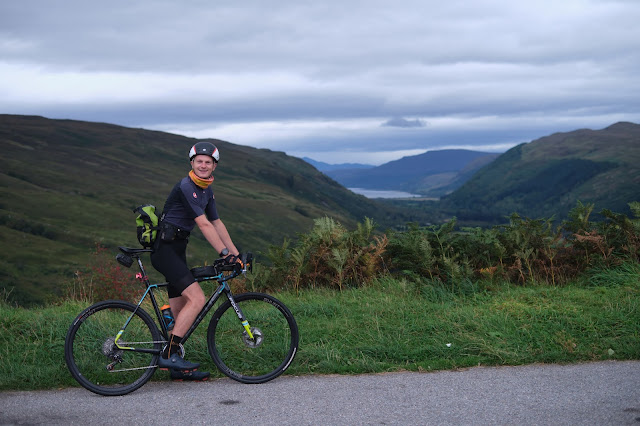
The North Coast 500 starts in the northern city of Inverness, weaves along the west coast to Applecross and then northwards towards the towns of Torridon and Ullapool. From there, it goes through some of the most northerly coastal points in Scotland, passing by Caithness and John o' Groats before heading south again through Dingwall and finally back to Inverness. There is never-ending back roads, wide meandering country tracks and beautiful bends through some of Scotland's finest coastal scenery.


Day 1: Inverness to Applecross

Stats

Distance: 83miles

Elevation: 4554ft

We began the day with our staple and regimented breakfast of muesli and warm croissants before getting our kit and bike ready for the day. Samuel and I set off at 7am sharpish from the campsite, it was perfectly located within Inverness and near a leisure centre. We utilised the swimming pool facilities the previous day; it was brilliant to get into the water to loosen out legs for a week of cycling. We cycled to the obligatory photo point of the official North coast 500 start point at the castle, which was located on a hill providing panoramic views over the river and Inverness.


The route for the first 70miles was flat; it is similar to South Derbyshire territory; harder to ride than you expect as you ride in a harder gear and cadence for the day with a limited variety of position or riding style. Once we cycled a few miles out of Inverness, we felt the sense of adventure had begun as the views were lovely whilst we closely followed the river. It is easy to get carried away and just cycle with your head down and not see anything, but in touring tradition, we ensured to capture the moments via video or photos to look back on for future reference. This trip was the first time where it would also be captured through a 3rd axis as Samuel had invested in a drone; the footage looks brilliant and can provide a perspective of the hills you are cycling up and the vast vistas of the open Scottish scenery. It was also refreshing that Samuel got to experience documenting the trip as I had mainly capturing our adventures until this point (4 years of various trips together).


We were lucky that the trip was not a typical touring setup as we had a complete support vehicle from my Dad; he drove around in his campervan. It meant all our supplies, food, bicycle repair equipment and sleeping arrangement were carried; this meant we only needed to cycle with minimal equipment to get us to the next campsite. This was brilliant and gave a great piece of mind if we did come into any mechanicals; we had spare cycle equipment, including wheels or a shelter to get into if the rain hammered it down! 


At 43 miles, we arranged to meet Dad for a quick lunch stop and hydration; firstly, we stopped at Midge bite café for Samuel to have an energy-boosting coffee. The café was appropriately named for the area because as soon as we were eating our sandwiches, the midges were out to eat us; or me specifically because my skins is just too tasty; I had over 10 bites in 10 minutes…the joy of Scotland. There was a multitude of cyclists who were also riding the NC500 but in a self-supported fashion; I don’t envy them cycling with a fully laden kit around the undulated route. Nonetheless, the lunch stop was brilliant because my Dad even heated up some delicious sausage rolls; it really was nice to get off the bike, take in the scenery around you and feel like you’re on holiday than a pure cycling challenge.

After we were refuelled, our energy remained topped up, and the scenery began to improve as the outlet from the sea was expanding, and the roads were reduced in size. The roads for most of the route were single track with regular passing places, the small villages were lovely, and the drivers were also incredibly considerate for the entire day. Most of them are all driving the route and were in large motorhomes enjoying the scenery and holiday, whereas cycling local to home has an increased number of road raging hooligan drivers.


The final kick of the day ended up the Holy Grail of the ‘UK’s top 100’ cycling climbs: Bealach Na Ba. It is cited as 11 out of 10 for difficulty, over 2000ft of elevation averaging 7% for 5.7miles.The switchbacks were impressive, and the towering mountains made the climb appear daunting; we received a few lovely acknowledgements from drivers of claps, cheers and waves as we were climbing up. The Bealach Na Ba was moist; visibility was 10 metres, and the road conditions were not terrible with potholes, but the general surface was rough, and vibration through the handlebars was the main issue. Once I reached the top, I was surprised by how easy it was. It wasn’t as deadly as the steep Lakeland Passes as I experienced the previous month during the Fred Whitton, but the weather was the most difficult aspect; up until this climb, the weather was beautiful, but it soon turned. Consequently, the descent off Bealach Na Ba, resulted in a very cold experience with numb fingers and shivering bodies gripping tightly onto our handlebars but fortunately we immediately got into the campsite which was located at the bottom of the climb. Samuel and I immediately got off the bike and headed straight to the showers and, to warm up after having sodden jersey and shorts for a few hours. 


Day 2: Applecross to Gruinard Bay

Stats

Distance: 76miles

Elevation: 5348ft

Day 2 was a spectacular ride with lovely coastal scenery for a large proportion of the route along the West Coast. We started cycling at 7am with a wonderful sighting of a stag on the coastal inlet of Applecross (at the campsite the previous evening we got up to 1metre away from it; it was incredibly tame). It was a purely stunning morning where Samuel flew his drone close to the stag and the surrounding bay where the morning skylight had some beautiful orange and red colours reflecting on the sea. We then had an undulated ride with some lovely swishy descents and punchy climbs to keep the first few hours interesting without it being too demanding on the legs. Fortunately, my legs were still feeling fresh which meant we were riding with a correct conservative touring pace; this is important to make the whole trip enjoyable without it feeling tough and unenjoyable.


We bumped into fellow North Coast 500 riders who we saw the previous day; they were riding self-supported and wild camping. It sounded that they had a rough night sleep and were close to packing in due to being eaten alive for most of the night by midges…ouch! 


We had our first drafting experience behind some gigantic motorhomes where we were swiftly freewheeling at 30mph. The faster we went on the flats meant more faff time for the film and photo set up which takes a significant length of our trip. But as usual it is always lovely to look back upon the memories as you soon forget the scenery and it all merges into one; the route is that dramatic and spectacular, you can see how it is increasingly popular for motorhome and cycle tourers.


In typical touring and multi day fashion, Samuel lived up to his mechanical reputation and I had to listen to a very creaky bottom bracket for the rest of the ride; fingers crossed he can fix it! 

At Kin Lockewe we met my Dad for lunch where we tucked into some warm sausage rolls and quiche which was lovely where we could stretch our legs out of the saddle whilst keep our energy topped up for the remaining 40 miles. 

Once we reached the campsite, it was breath-taking, we were a few metres from the beach, it was a beautiful location. The weather for the whole day was brilliant for September, it resulted in some great photos and we could take in the cycle touring atmosphere and soak up the scenery we were riding through instead of head down and slogging. We regularly got off our bikes, looked around and had a snack; it is these moments I cherish and believe are key elements to a successful touring trip.


Day 3: Gruinard Bay to Clachtoll

Stats

Distance: 77miles

Elevation: 6119ft

This morning begun with a beautiful sunrise overlooking the bay which we were camping on. Setting off at 7am provides a lovely hour of blue skies and colourful sea water, it provides a great motivation to get up early and wake up the legs, albeit, today, I was quickly woken up by Samuels consistently loud creaky bottom bracket; unfortunately, he couldn’t fix it as it appears to be a gritty bearing. 


The North Coast 500 route so far provided a wealth of variation of scenery between closely cycling to the shoreline to more mountainous inland tracks; it was living up to its expectation so far as a stunning cycling route.


At mile 17 we approached a 6-mile steady climb; however, we were rewarded by a stunning and fast descent which later led to Ullapool. Ullapool was the most habituated area of the ride so far with a multitude of shops and restaurants; there was a large ferry which was lovely to see while we were indulging into our lunch in the campervan. 

There were 14 climbs for the route, some were deceptive and taking a toll on the legs, but my Garmin did pre-empt the hills and with regular snack stops and media recordings this broke up the hard route ahead.


After Ullapool, we came off the main road via some very narrow single-track lanes for 25 miles which eventually led to Lochinvar. It was beautiful to come off the official NC500 touring route as we could cycle side by side and take in some beautiful fast and twisty adrenaline roads which were stunning to cycle through. 


Over the first 3 days we have been lucky with traffic as the hundreds if not thousands of motorhomes we had already seen were all driving in the opposite direction; we felt safe and not on edge to keep looking back. It did help, that we were both kitted out with our bright exposure lights for the front and back of our for the entire trip; it did highlight to us how hard it would be to have day running light if we were self-sufficient (a dynamo setup would almost be a necessity to charge all of the electricals).

The remainder of the route to the campsite was more undulated with lots of punchy climbs. Samuel had a coffee stop in Lochinver to revitalise his caffeine hit with a flat white (the cafe also sold over 50 types of pies!). Samuel must have foreseen what was to come as we had to battle through some very powerful headwinds before we reached the campsite, fortunately whilst he was caffeine fuelled, I drafted behind him to shelter from the wind, it was a technique we quickly adopted to keep rotating the front to share the hard shift of cycling in the wind.


The campsite was beautiful, it had a full laundry, showers, and even cooking facilities (not that we needed them due to having a full chef and supported on route; it was a luxury having dad continually shift the added load associated with touring, all Sam and I needed to do was cycle). You could also borrow kayaks and wetsuits for free too, it is definitely a site I would recommend!


The evening rained solidly so we relaxed, put our feet up and hoped that the following day remained dry. Considering we were cycling in September the weather was perfect, not too hot or cold and there was less traffic to contend with than summer.

Day 4: Clachtoll to Bettyhill

Stats

Distance: 97miles

Elevation: 8048ft

The first 20 miles consisted of 10 climbs along some beautiful single-track roads which were beautiful, albeit windy. It was a tough day physically with a total of 22 climbs, but I predominantly had a mental challenge to overcome. I had a smashed mirrorless camera and ripped Gore-Tex coat after my bumbag unclipped off my waist early into the day. It was an expensive disaster that I had to quickly divert my attention from or otherwise, low points can worsen and significantly grind you down. Fortunately, through experience of long-distance endurance challenges I have built up a level of mental robustness to respond to the multitude of low points experienced through challenges of this type. 


As the route veered off the West Coast, the views were less stunning, but there were still some nice coastal inlets; in particular we saw Navy boats and subsequent training along the coastline; this proved valuable at stimulating our brain along a tedious 10-mile bay. 

We soon met my Dad at Tongue which had wide views of the beach and a stunning bridge. It was refreshing to get off the bike and reset the mindset whilst tucking into some food. Just 5 miles after the snack stop in the van, we had a further fuel stop at a Café for tea and cake; we were still having mental battles with the route with relentless climbs and distance. Fortunately, the café stop proved effective at resetting our mindset for the remainder of the day; it is amazing what sugar can do for a morale boost. You never can predict the high and lows of a long-distance trip and that is what makes the challenge so fun and unique due to the regular barriers you have to overcome!


However, it is unfortunate that we were counting down the miles throughout the day and not enjoying it to the same extent as the previous days, but the route quickly became an anticlimactic experience with a sudden change from towering mountains to more undulated scenery which we had to adjust to as well as the inevitable fatigue from the difficult multi day terrain. 


Day 5: Bettyhill to Helmsdale

Stats

Distance: 107miles

Elevation: 5912ft

The morning started with the sound of rain pinging off the campervan roof before we had to run up to Betty Hill to the public toilets to get changed and ready for the day ahead of us; the campsite we were staying on had no facilities but electric hook up; it was a strange priority. I wanted to start cycling as soon as possible as it was wet, and my legs were being eaten alive once again while we were propping our bikes before setting off. I had dozens of midge bites; Fortunately, I took anti histamines a week prior to the trip and each day which reduced the itchy sensation, but they were still not a pleasant experience.

The first 50 miles to John o Groats along the North Coast was a slog; the heavy rain was persistently driving into our face and filling my gloves and soaking my shoes. I was beginning to question why I didn’t just tour the route in a Motorhome but once again this is what endurance challenges are about, overcoming the mental demons in your head and this day was one a day of mental demons; arguably the hardest ride I have mentally done.

Samuel and I were grinding at the pedals and appeared to have a headwind for majority of the day, we had to surrender into a bus shelter for 30 minutes to escape the rains and wait for my Dad to fuel us with hot tea and food; it was a huge morale boost when we saw him rolling up to us.

Once we had the obligatory photo at John o Groats, we powered to Helmsdale via a small road that ran parallel to the a9. We planned this with the intention of a more scenic route and to avoid the busy route, however it was dull, it was a straight 30mile road with many false summits, strong headwinds abs steady climbs which resulted in one of my worse ever 100 mile rides. The boredom was at another level, the speed was like treacle and the day had drastically changed since the West Coast during the first two days of the trip. I was struggling to get over the disappointment of the route as it purely became a slog of counting down the distance to Helmsdale. I couldn’t find anything of interest to take my mind off the distance (it was a long day of over 105miles) and I don’t think Sam did either; we had a few days of very tough cycling with more mental battles than we had experienced before; it wasn’t the physical challenge; our legs were feeling fine. 


A huge morale boost was we had some luxurious accommodation at Samuels great aunt; we had a wonderful evening of hearing stories of the living in northerly Scotland -18 winters put me off. Samuel  cooked a casserole and we were fuelled and reset to bring closure to a very difficult day so we could shift to a positive mindset in preparation for the last day.

Day 6: Helmsdale to Inverness

Stats

Distance: 92miles

Elevation: 4843ft

The final day began with a beautiful sunrise over the east coastline. It was considerably colder than any other day at 7 degrees (almost half the temperature of the previous days). Consequently, our toes and fingers with beginning to lose a sense of feeling especially as we closely followed a loch which had added cold spots that was even cold on your chest when you breathed. 

This day had much more variable scenery than the previous day/s with rolling hills, small twisty roads and views to keep our mind stimulated (hooray!)  


At mile 25 we huddled in the van for a warm hot drink to defrost and continued to the Falls of Shin which we visited 4 years ago during our LEJOG (Lands End to John o Groats) trip. It wasn’t as impressive this time as previously we spotted salmon leaping metres in the air (they can leap up to 12 metres!). 

Nevertheless, it was lovely to keep stopping off and breaking up the distance until Samuel and I began to put the power on the pedals as we knew there wasn’t much distance remaining before until we reached the busy city of Inverness and weaved our way through the main roads to the castle where we set off 6 days ago. 


Conclusion

To conclude the North Coast 500 has been completed, 6 days was appropriately planned from a challenging perspective both physical and mental. If we were full laden up, extra days would be advisable as the West Coast is unforgiving with its undulations and the route consistently provided tricky road surfaces that regularly resembled gravel tracks; it was the constant vibration limiting the rolling speed as opposed to deep potholes. Nevertheless, the equipment choice of using my carbon cyclocross with 32mm tubeless tyres resulted in a successful choice to complete the route where I had comfort, low rolling resistance compared to a large gravel tyre and ultimately, I got zero mechanicals or punctures. 


Upon reflection, I would recommend the route but with the advisory to ride the West Coast and then back down the middle of Scotland to improve the overall trip experience from a view and road perspective; the east coast is dramatically worse and is an anti climax if you ride in the same direction as I did.

Nevertheless, I am happy to have completed the route with Samuel in six days with minimal disruptions or low points (apart from day 5) within a short time period due to our busy lives of us both soon starting next career steps: Samuel as a retail assistant and myself as a PhD scholar. 

It is incredibly important to note, this challenge would not have been possible without the commitment of my dad who supported us along the route through driving the route, cooking and being piece of mind that we would be left in Scotland in case we had any mechanicals as there was very few bike shops or provisions on route. As well as my dad also driving the whole Nc500 he drove 450miles in a day on the way back as I had to start university the day after. He totalled over 1500 miles in a week which is incredible; we are eternally grateful for his support and I’m sure he had many mental barriers to overcome similar to our cycling experience!


Saturday, May 22, 2021

My first 250 mile ride

 I have completed a few 200-mile rides and some long-distance challenges in the past, including last years 180mile Everest; hence my long term aim is LEL (London Edinburgh London: 1500km) and PBP (Paris Brest Paris: 1200km). Thus this year, I needed to steadily increase my distance; 250 was the aim for this ride with a 400mile aim by the end of the year to be completed within 24hrs.


Samuel had wanted to do 200 for a while; this was a perfect opportunity to have some company for part of the day. To further make the challenge an enjoyable process, we entered the Lincoln sportive; we cycled 50 miles to the Newark showground, then cycled the 100mile sportive at 17mph called Beyond Lincolnshire, which I thought was a fitting title to summarise the day. After the sportive, I then cycled a 100mile warm down to get back home and find a few hills around Bakewell and Chatsworth; the route was incredibly flat, thus to make the stats look more than just a 250mile flat route, a few hills were required.


Flat rides present their own challenges, 1 being you constantly pedal, 2 you are in the same riding position all day, and the third and most challenging one, particularly pertinent around Lincoln, are headwinds. Headwinds are mentally tough as you can be average 22mph. Then you turn a corner and hit an imaginary brick wall of wind which makes double-digit speeds a challenge that eats into your energy reserves and muscular endurance through long term low cadence grinds.


The finish line of the sportive: 150miles in and 100 miles remaining


This was my best day for nutrition; I usually really struggle to eat on the bike, which is obviously the main limitation for endurance sports, but I was ravenous all day; I had two McDonalds (breakfast and dinner) and a multitude of waffles, sweets, crisps. By incorporating a sportive within the challenge, it helped ensure I ate at every food station. I also had free lifts throughout the day; I'd often hop on the back of a fast group of riders and have sections of riding at 22mph with little effort due to the drafting effect. This was especially important during the headwinds;  I would look around with great focus for the biggest group or rider to tuck behind when the wind was present.


All in all, it was a great day; up until 200 miles, I completed it with ease. 200-250miles was where the challenge began, it was cold, dark, and energy reserves were diminishing. The solo effort of the final section made the challenge a tough mental battle to get through, but in the end, I did it and can confidently say I still have more miles in my legs for another day. 


To note, it was also a lot of fellow friends and Belper harriers first 100-mile sportive; I'm proud to have been part of inspiring and setting up the cycling subdivision for our running club. To see runners turned cyclist enjoy another aspect to the outdoors and pursue a notable achievement of a century is remarkable progress within one year of training! Hopefully, it is the start of club bike packing trips and longer rides together.